


Pine St. lawsuit was a thing
- Dale C. Maley
- Feb 17
- 4 min read
It has now been 150 years since the first Fairbury Fair was held in 1876. It isn't easy to research the early years of the Fairbury Fair because copies of the Fairbury Blade newspaper are not available until the early 1880s.
In the 1890s, the Fairbury Fair (then called the Fairbury Union Agricultural Board) became involved with a lawsuit regarding what is now Pine Street. This lawsuit ended up being resolved by the Illinois Supreme Court in 1897 (Fairbury Union Agricultural Board v. Holly). The details of this lawsuit include rare information about the formation of the Fairbury Fair in 1876.
Fairbury was founded in 1857 when the Peoria & Oquawka Railroad laid its tracks from Peoria to the Indiana border. When the new railroad was approaching what is now Fairbury, Caleb Patton wanted it to run through his farm so he could make a lot of money by converting farmland into city lots. Mr. Patton offered railroad engineer Octave Chanute half of these new building lots if Mr. Chanute agreed to run the railroad through his farm. Octave Chanute accepted his offer. Today, the railroad, now called the TP&W, still owns lots in Fairbury.
Caleb L. Patton also owned a farm adjoining the town of Fairbury on the south. In February 1864, he platted an addition to "the town on the north part of his farm. The streets in this addition running north and south were numbered First, Second, Third, Fourth, Fifth, Sixth, and Seventh, commencing on the west side of the addition.
There was no street or alley connecting the south ends of these streets, but each one ended at the north line of the remaining farm lands. After laying out the addition, Mr. Patton said that he would lay an alley through there, and he measured off twenty feet in width for that purpose, the entire length of the addition, and set stakes to mark the south line.
The addition was then in a meadow included with the farm, and so remained until the fall of 1864, when he sold the farm to Americus L. Pogue and told Pogue that he had left the strip out there for a road or street. He said to Pogue, "If I make this deal, I have promised the people I would leave a strip."
Pogue, with the intention of carrying out Patton’s purpose, removed the old fence from the north side of the addition, and reset it, with additional material, on the south line of the alley, leaving the strip outside for a road.
A hedge was planted inside the fence and close to it, which grew up and formed a fence when the boards were finally removed. In selling lots in the addition, Pogue told the people that there would be a road through there.
He afterwards subdivided the lands south of the alley into acre lots, and told the surveyor who laid it out about the roadway. He did not intend that it should be included in the survey of the acre lots, but the surveyor said that it was the correct way to do it, and the roadway was therefore included in the survey. This was proper, since the fee was in Pogue, although burdened with the public easement.
Pogue sold different acre lots, thus surveyed, and finally, on December 19, 1868, sold most of them to I. P. McDowell. He told McDowell that the strip was designed for a street, and they both understood and considered that it was a street. It was then an open way through which people rode and drove.
McDowell owned and occupied the premises so purchased until appellant was organized in 1876, when he sold them to it for its fair grounds. That summer, the appellant built a board fence eight feet high along the south line of the alley, leaving it outside, as before.
At the west end of the alley, Deacon Shepard, who did not own or claim to own the fee but owned property in block 7 of the addition, had extended his fence across it and used it for stacking hay and for private purposes, as some witnesses thought, for one year, while others thought it was longer.
When the Fairbury Fair bought the land from McDowell and put up its fair ground fence, it required Shepard to remove his cross-fence, which he did, so as to leave out a strip for public use.
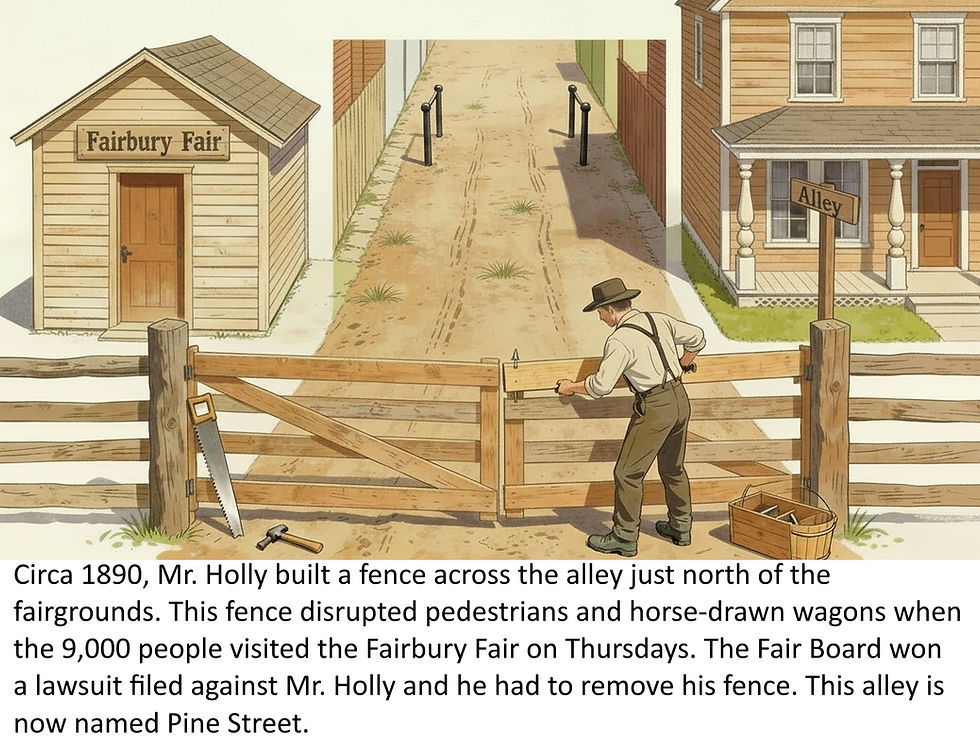
In 1889, Mr. Holly acquired title to the south two hundred feet of block 7 in the addition across the alley from the fair grounds, and during that summer, or the next one of 1890, extended its fences across the alley, closing it between First and Second streets and including it in the fair grounds.
Mr. Holly's fence was the first act of obstruction or interference with the public easement by any owner of the fee in the land upon which the alley was located since it was first turned out to the public, about twenty-five years before.
Thousands of people traveled to Fairbury by horse-drawn buggies and came by passenger train to attend the Fairbury Fair each summer. Often, 7,000 to 9,000 people attended the Fairbury Fair on Thursdays. By erecting fences across the alley (now Pine Street), Mr. Holly created problems for pedestrians attending the Fairbury Fair.
Because Mr. Holly refused to remove his fences across Pine Street, the Fairbury Union Agricultural Board filed a lawsuit against Mr. Holly. The case wound its way through the court appeals process and ended up at the Illinois Supreme Court in 1897.
The Illinois Supreme Court sided with the Fairbury Union Agricultural Board, and Mr. Holly was ordered to remove his fences. The main reason the Supreme Court decided in favor of the Union Agricultural Board was that Caleb Patton told many witnesses he was donating the land for a public alley, and then the alley was used by the public and maintained by the City for 20 years before Mr. Holly put up his fence.
This simple dispute over an alley turned into an Illinois legal landmark. After the Supreme Court decided this case, whenever there was a dispute about an alley, the 1897 Fairbury case was cited as precedent.
Since we do not have any old Blade newspapers until several years after the Fairbury Fair started in 1876, this lawsuit provides valuable historical information about the property now used every year for the Fairbury Fair.
(Dale Maley's weekly history feature is sponsored by Dr. Charlene Aaron)


Comments