


Fair changes over the years
- Dale C. Maley
- Apr 27
- 4 min read
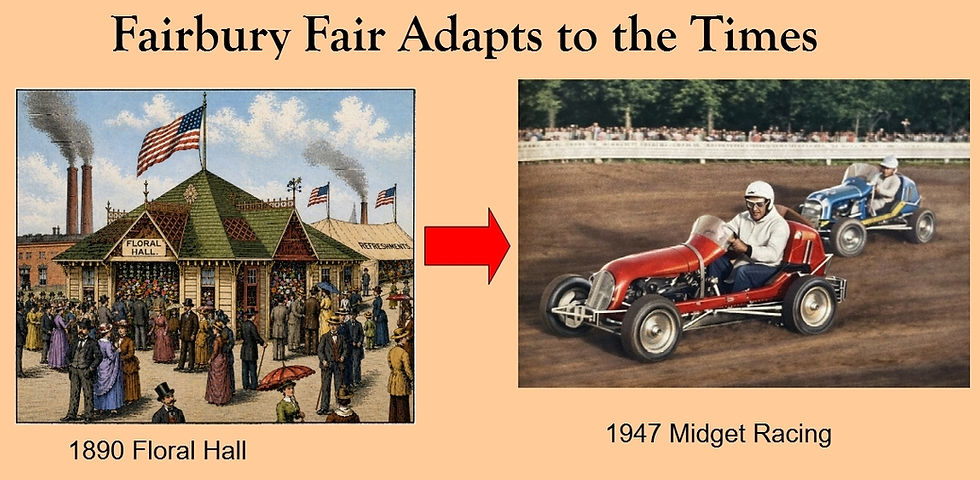
The Fairbury Fair has been an important part of community life in Fairbury for nearly 150 years.
Over that long period, the fair has changed in many ways. While the early fairs focused mainly on agriculture and livestock, later fairs added entertainment acts, auto racing, carnivals, and many other attractions. Despite these changes, the fair has always remained a gathering place for families and friends from Fairbury and surrounding communities.
The first Fairbury Fair was held in 1876. At that time, Livingston County was largely a farming region, and agricultural fairs were very popular across the Midwest. Farmers brought their best livestock, crops, and farm products to display and compete for prizes. These exhibitions allowed local farmers to compare their work with others and learn about improved farming methods.
In the early years, transportation to the fair was very different from today. Most visitors arrived by horse-drawn wagons or buggies. Some people also came to Fairbury by railroad. Special excursion trains were sometimes arranged to bring visitors from nearby towns. When the weather was favorable, several thousand people could attend the fair on a single day.
Horse racing quickly became one of the most popular attractions at the early fairs. Many county fairs across Illinois featured horse racing, and the Fairbury Fair was no exception. Crowds gathered around the racetrack to watch the races and cheer for their favorite horses and drivers. The races often drew large crowds and were among the fair's highlights.
In addition to horse racing, early fairs also featured agricultural displays, livestock judging, and exhibits of farm machinery. These exhibits were important to the farming community because they allowed farmers to see new equipment and improved farming techniques.
Many residents took great pride in showing their livestock and crops at the fair.
By the late nineteenth century, fairs across the country began adding entertainment attractions to draw larger crowds. The Fairbury Fair followed this trend. Traveling performers and novelty acts began appearing at the fairgrounds to entertain visitors.
Some of these performances were quite unusual by modern standards. Balloon ascensions and parachute jumps were among the most thrilling attractions of the era. Spectators would gather on the fairgrounds to watch daring aeronauts rise high into the sky before descending by parachute.
One of the most remarkable acts ever presented at the Fairbury Fair occurred in 1899 when Miss Ida LeRoy performed a spectacular balloon stunt. In this daring exhibition, a large hot-air balloon lifted a cannon high into the air. Once the balloon reached a great height, Miss LeRoy was fired from the cannon and descended safely to the ground with a parachute. For the thousands of people watching from the fairgrounds below, it must have been an unforgettable sight.
During the early twentieth century, entertainment at the fair continued to evolve. Traveling vaudeville performers, magicians, acrobats, and animal acts were often featured in the free grandstand shows. Newspaper advertisements in the Fairbury Blade frequently promoted these acts as some of the most exciting attractions ever presented at a county fair.
As the twentieth century progressed, new forms of entertainment began to appear at fairs across the country. One of the most important changes was the introduction of automobile racing. As automobiles became more common in everyday life, racing quickly became a popular spectator sport.
The Fairbury Fair eventually added auto racing to its list of attractions. Crowds gathered at the racetrack to watch drivers compete in stock car and midget races. These events brought a new kind of excitement to the fairgrounds and attracted many racing fans.
The fair also began to include larger carnivals and midway attractions. Traveling carnival companies brought rides, games, and food stands to the fairgrounds. For many children and young adults, the carnival midway became one of the most exciting parts of the fair.
Despite the many changes in entertainment, the agricultural traditions of the fair continued. Livestock shows, crop exhibits, and 4-H competitions remained important parts of the event. These activities helped preserve the fair's original purpose while allowing it to grow and adapt over time.
The Fairbury Fair has also endured many challenges during its long history. The fair continued through difficult periods, including World War I, the Great Depression, and World War II. In recent years, the fair also faced disruptions due to the COVID pandemic. Each time, dedicated volunteers worked hard to ensure that the fair would continue.
The success of the Fairbury Fair over the past 150 years is largely due to the efforts of these volunteers. Generations of residents have given their time and energy to organize the fair, maintain the fairgrounds, and plan the annual events.
Today, the Fairbury Fair still brings people from across the region together. While modern fairs may include different attractions than those of the past, the spirit of the event remains much the same. Families come to the fair to enjoy the entertainment, visit exhibits, and spend time with friends and neighbors.
From horse-drawn wagons and balloon ascensions to auto racing and carnival rides, the Fairbury Fair has continually adapted to the changing times. Yet through all of these changes, the fair has remained one of the most enduring traditions in the Fairbury community.
(Dale Maley's weekly history feature is sponsored by Dr. Charlene Aaron)


Comments