


Early Fairbury secret societies
- Fairbury News staff
- Jun 15
- 6 min read
The 1889 Blade newspaper published a long article about the history of Fairbury since its founding in 1857, when the Peoria & Oquawka Railroad laid its tracks from Peoria to Indiana.
The arrival of the railroad transformed a stretch of prairie into a thriving village almost overnight. Businesses sprang up quickly along Locust Street, homes were built, churches were organized, and before long, the little town had developed the institutions that helped bind the community together.
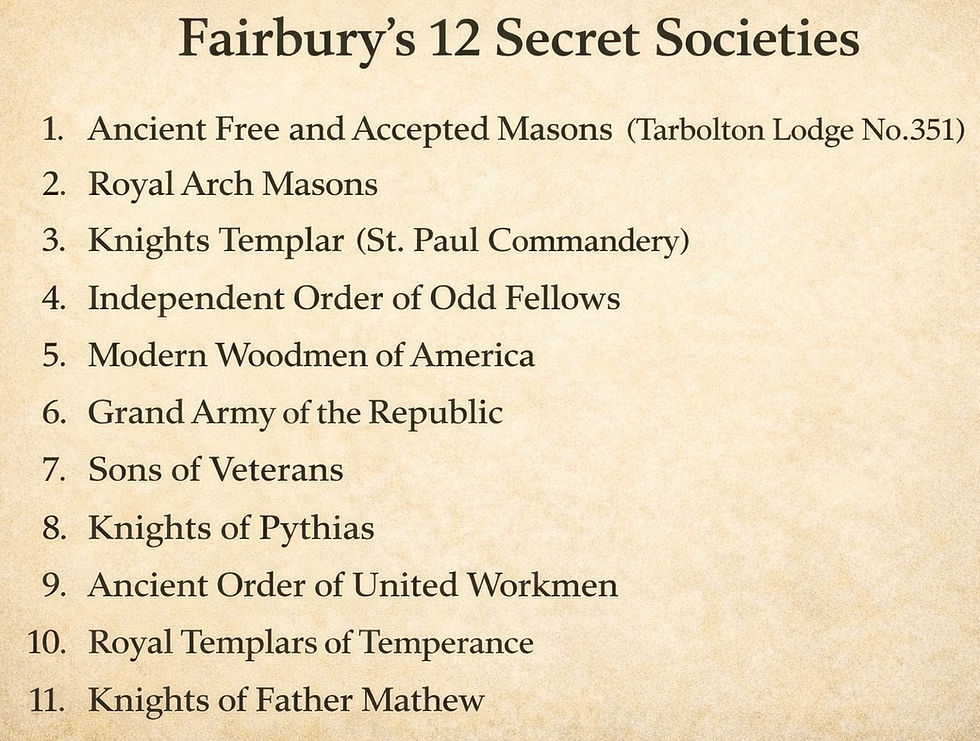
One of the more interesting sections of that 1889 article described the number of fraternal and temperance organizations in Fairbury at the time. In 1889, Fairbury had a population of about 2,500 people. Yet in that relatively small village, 12 secret societies met regularly. These organizations provided fellowship, insurance benefits, moral guidance, and social activity for their members. They also played a major role in shaping the community's character during the town's early years.
The oldest of these organizations in Fairbury was the Ancient Free and Accepted Masons, represented locally by Tarbolton Lodge No. 351, which was chartered in 1860. The national roots of Freemasonry trace back to the guilds of stonemasons in Europe during the Middle Ages. Over time, the organization evolved into a fraternal society that emphasized moral conduct, charity, and mutual support. Many well-known leaders in American history were members of the Masons, including George Washington and Benjamin Franklin.
Tarbolton Lodge was organized on October 3, 1860, when nine Fairbury residents applied for a charter to form a Masonic lodge in the young village. The lodge was named after Tarbolton, Scotland, in honor of the famous poet Robert Burns, whose writings were admired by two of the charter members. Over the years, Tarbolton Lodge has remained an important part of community life in Fairbury. Today, more than 160 years after its founding, the Masons are still active in the community and continue to support local causes and educational scholarships.
Closely following the Masons in the early history of Fairbury were the Royal Arch Masons. The Fairbury Chapter of the Royal Arch Masons was chartered in 1866. The Royal Arch degree is considered an extension of traditional Masonic membership and dates back to the 1700s in England. Members of this organization met regularly in Fairbury for many years, but the chapter eventually became inactive as membership declined in the twentieth century.
Another related organization in the early years of Fairbury was St. Paul Commandery of the Knights Templar, which was also chartered in 1860. The Knights Templar is a Christian-oriented branch of Freemasonry whose traditions date back to the medieval Crusades. In the nineteenth century, membership in the Knights Templar was considered an honor among Masons who had completed additional degrees. Like the Royal Arch Masons, the Knights Templar organization in Fairbury eventually ceased operations over the years.
Among the most active fraternal organizations in early Fairbury was the Independent Order of Odd Fellows. This organization met each Tuesday evening, while its encampment met on the second and fourth Monday nights of each month. The Odd Fellows originated in England during the eighteenth century, where working-class men formed societies to provide financial assistance to members in times of illness or death. The organization was brought to the United States in 1819 and quickly spread across the country.
In Fairbury, the Odd Fellows lodge was chartered just nine days after the Masonic lodge in October of 1860. From those early beginnings, the organization became a permanent fixture in the town's life. The Odd Fellows built a large lodge building on West Locust Street in 1895 and were known for their charitable work and community involvement. Like the Masons, the Odd Fellows have continued to operate in Fairbury into modern times and remain one of the few nineteenth-century fraternal organizations still in the community today.
Another well-known organization in Fairbury during the late nineteenth century was the Modern Woodmen of America. This group held its meetings on the second and fourth Wednesday evenings of each month. The Modern Woodmen was founded in 1883 in Lyons, Iowa, as a fraternal insurance society that provided financial protection to families in case of death or disability. The organization grew rapidly across the Midwest, especially in farming communities like Fairbury. Although the Modern Woodmen of America still exists nationally, the local organization in Fairbury eventually became inactive.
The Grand Army of the Republic was another important organization in the years following the Civil War. The local post in Fairbury held its meetings on the second and fourth Friday evenings of each month. The Grand Army of the Republic was founded in 1866 as an organization for Union Civil War veterans. In communities across the country, these veterans gathered to share memories, support one another, and promote patriotic values.
In Fairbury, the Grand Army of the Republic played a significant role in civic events and Memorial Day observances. As the years passed and the Civil War generation grew older, membership gradually declined. By the 1920s, the last of the Fairbury Civil War veterans had passed away, and the local post of the Grand Army of the Republic came to an end.
Closely connected to the Grand Army of the Republic was another organization, the Sons of Veterans. This group met on the first and third Friday evenings of each month and was composed primarily of the sons of Union veterans. The organization was founded in 1881 to preserve the memory of the Civil War and to carry on the patriotic traditions established by their fathers. Like many fraternal organizations of the period, the Sons of Veterans eventually disappeared as the generation that supported it faded from the scene.
The Knights of Pythias was another secret society that held its meetings each Thursday evening in Fairbury. This organization was founded in Washington, D.C., in 1864 during the Civil War. Its purpose was to promote friendship, charity, and benevolence among its members. The Knights of Pythias became one of the largest fraternal organizations in the United States during the late nineteenth century. In Fairbury, the lodge was active for many years but eventually closed as membership declined.
In addition to the organizations already mentioned, the Ancient Order of United Workmen also maintained a presence in Fairbury. This group was founded in Pennsylvania in 1868 and was one of the earliest fraternal benefit societies to offer life insurance to its members. During a time when few families had financial protection, organizations like the Ancient Order of United Workmen provided an important safety net. The local lodge in Fairbury eventually disbanded as other forms of insurance became more widely available.
Temperance organizations were also common in communities across the Midwest during the late nineteenth century, and Fairbury was no exception. One such group was the Royal Templars of Temperance. Founded in the 1870s, this organization promoted abstinence from alcohol and encouraged moral behavior among its members. The Royal Templars held meetings in Fairbury for many years, but gradually disappeared as public attitudes toward temperance changed.
Another temperance-related organization in Fairbury was the Knights of Father Mathew, named after Father Theobald Mathew, an Irish priest who became famous for his work in the temperance movement during the nineteenth century. The Knights of Father Mathew encouraged members to take pledges to abstain from alcohol and to support one another in maintaining sobriety. Like many other temperance societies, the organization eventually faded away as the social climate changed in the early twentieth century.
The Ancient Order of Hibernians also had an organization in Fairbury during the late nineteenth century. This group was founded in Ireland and later established in the United States to assist Irish immigrants and promote Irish culture and Catholic values. In many communities, the Ancient Order of Hibernians provided social support and protection for newly arrived immigrants. The Fairbury organization was active for a time but eventually became inactive as the local population changed.
The 1889 Blade article concluded with a statement that reflected the importance of these organizations in shaping the character of the community:
“The moral and social condition of a village of 2,500 people cannot be had while so many institutions, having for their object the promotion of the moral and social welfare of the community, include among their members so large a part of the population and receive so generous a support as they do here. These churches and societies can not fail to exercise a healthful influence, and powerfully aid the development of a high moral tone in the community and fraternal feelings among its members.”
Community organizations have been part of Fairbury's history since its founding in 1857. Over the years, some groups have died out, while others have formed. The only two of these twelve societies still active today are the Masons and the Odd Fellows.
Dale Maley's local history feature is sponsored by Dr. Charlene Aaron.


Comments